
PTFE Fine Powder · CAS 9002-84-0
PTFE Fine Powder Supplier in China
Huafluoro is a professional fluoropolymer manufacturer in China, supplying high-performance PTFE Fine Powder for paste extrusion, tubing, wire & cable insulation, sealing materials, and industrial applications requiring excellent chemical resistance and thermal stability.
✓ Exceptional Thermal Stability
✓ Outstanding Chemical Resistance
✓ Excellent Paste Extrusion Performance
What is PFA?
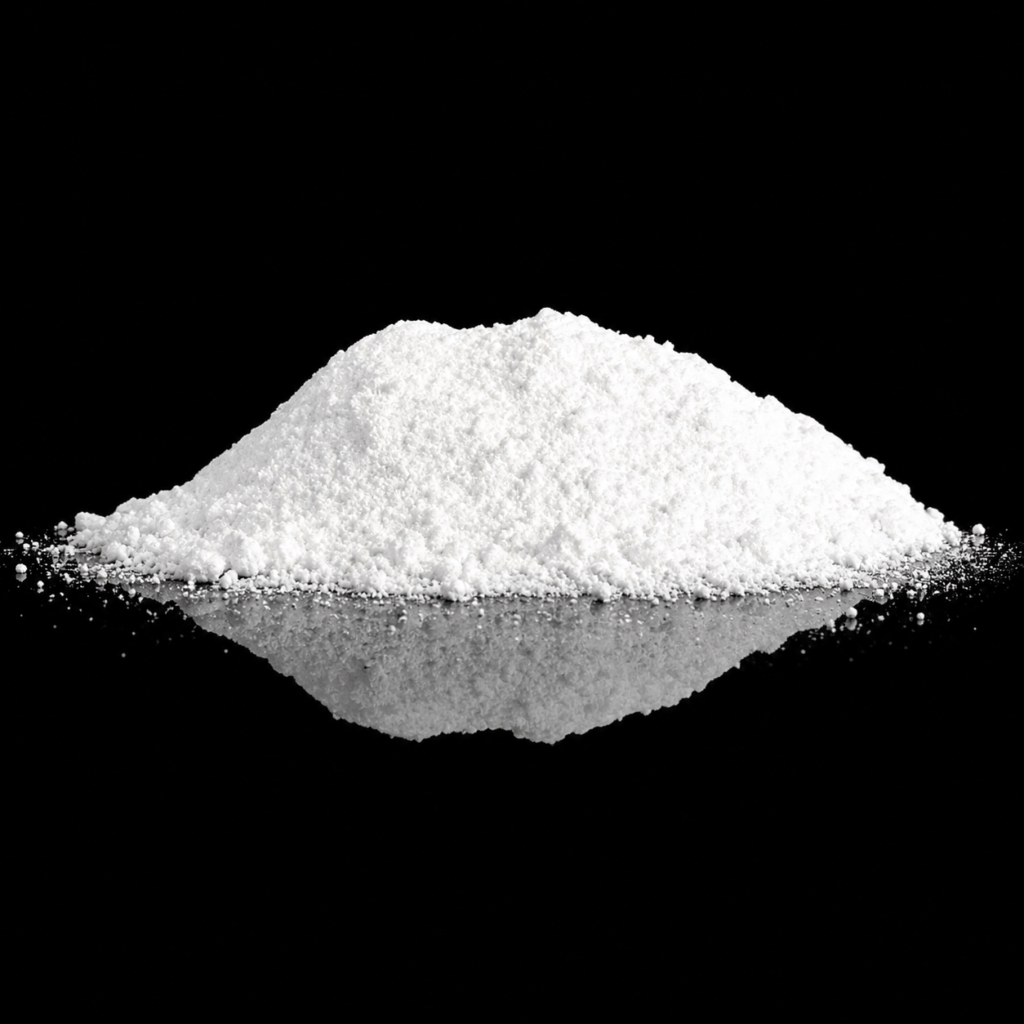
PTFE fine powder is in the form of white powder with excellent chemical resistance, lubricantproperties, wide service temperature range, and dielectric performance. It can be processed bypaste extrusion.
| Grade | Average Particle Size | Tensile Strength ≥ (Mpa) | Elongation ≥ (%) | Process | SSG | Applications |
|---|---|---|---|---|---|---|
| HF-14 | 550±150 | 30 | 330 | Paste extrusion | ≥ 2.191 | Sealing tape, staple fiber |
| HF-14G | 550±150 | 30 | 330 | Paste extrusion | 2.151-2.190 | Pipes, large size coaxial cables, staple fiber |
| HF-14T | 550±150 | 32.5 | 330 | Paste extrusion | ≤ 2.156 | Biaxially stretched film |
| HF-16 | 550±150 | 32.5 | 330 | Paste extrusion | 2.151-2.180 | Filament yarn, Biaxially stretched film |
| HF-16T | 550±150 | 32.5 | 330 | Paste extrusion | ≤ 2.150 | Biaxially stretched film |
| HF-32 | 550±150 | 30 | 330 | Paste extrusion | 2.145-2.170 | Pressure-resistant transparent tube |
Package: 25kgs plastic drum, 20kgs paper drum.
Storage and Handling: PTFE fine powder must be handled carefully to avoid excessive shearing and particle fibrillation.Fibrillation is not reversible and damaged particles can appear as defects in the finished product. It must be handled below19°C because above this temperature the powder is softer and can be more easily laminated. It is recommended sieving ofpowders below 19°C before adding lubricant. Strong vibrations and shocks must be avoided as much as possible for preventlumps formation. Storage and transportation should be carried outin the range 5-19°C. Moreover, the powders must be storedon a dry room because the absorption of moisture could negatively affectits processing. Storage and handling facilities shouldbe clean since even housekeeping and careful handing are essential.
Applications of PTFE Fine Powder
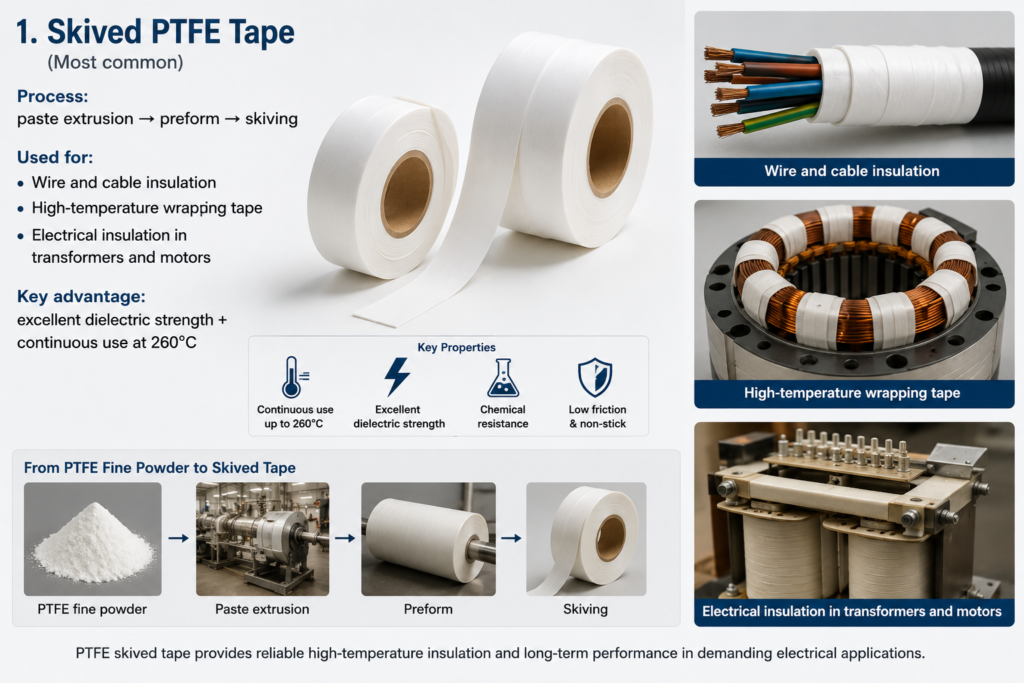
1. Skived PTFE Tape
- Process: paste extrusion → preform → skiving
- Used for:
- Wire and cable insulation
- High-temperature wrapping tape
- Electrical insulation in transformers and motors
- Key advantage: excellent dielectric strength + continuous use at 260°C
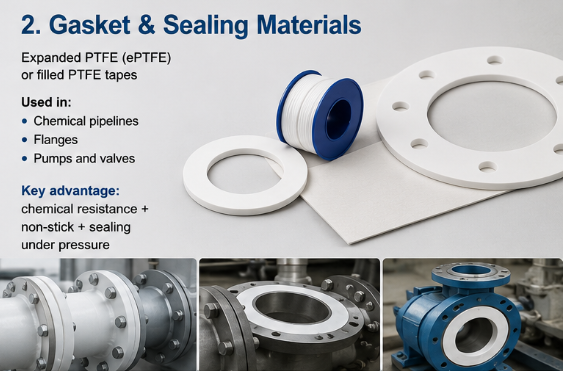
2. Gasket & Sealing Materials
- Expanded PTFE (ePTFE) or filled PTFE tapes
- Used in:
- Chemical pipelines
- Flanges
- Pumps and valves
- Key advantage: chemical resistance + non-stick + sealing under pressure
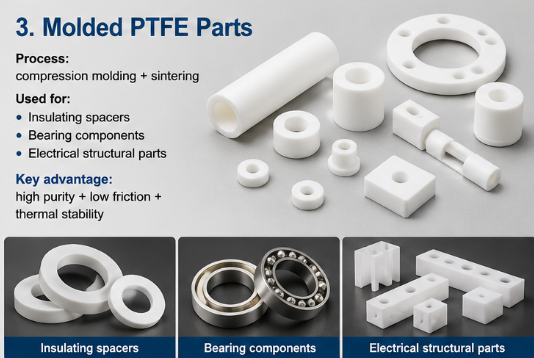
3. Molded PTFE Parts
- Compression molding + sintering
- Used for:
- Insulating spacers
- Bearing components
- Electrical structural parts
- Key advantage: high purity + low friction + thermal stability
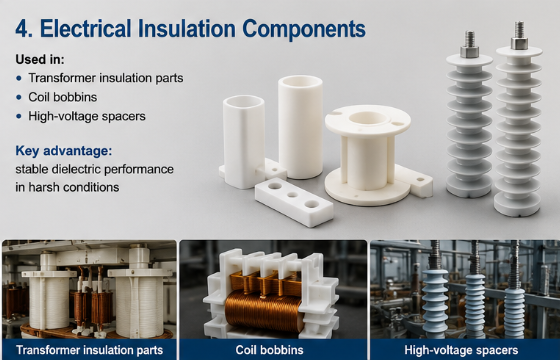
4.Electrical Insulation Components
- Used in:
- Transformer insulation parts
- Coil bobbins
- High-voltage spacers
- Key advantage: stable dielectric performance in harsh conditions
PTFE Fine Powder Resin Processing
1. What is PTFE Fine Powder?
PTFE fine powder is:
- A high molecular weight fluoropolymer resin
- Produced by emulsion polymerization
- Appearing as fine white powder
- Non-melt-processable (does not flow when heated)
2. Typical Processing Steps
1. Preforming
PTFE fine powder is:
- Mixed with a processing aid (lubricant)
- Cold-compressed in a mold
This forms a “green” preform with basic shape but low strength.
2. Forming (Paste Extrusion or Compression Molding)
Depending on the final product:
- Paste Extrusion
- Powder mixed with lubricant and extruded
- Used for tubes, tapes, films
- Compression Molding
- Powder pressed into shapes under high pressure
- Used for gaskets, seals, blocks
3. Lubricant Removal
- The processing aid is removed by heating or drying
- Prepares the material for sintering
4. High-Temperature Sintering
This is the key stage:
- Temperature: around 360–380°C
- PTFE particles fuse together without true melting
- Polymer chains coalesce into a dense solid structure
5. Controlled Cooling
- Slow cooling is required
- Ensures dimensional stability and avoids internal stress
FAQ of PTFE Fine Powder
1. What is the difference between PTFE Fine Powder and PTFE Molding Powder?
- PTFE Fine Powder is designed for paste extrusion processes.
- PTFE Molding Powder is mainly used for compression molding and ram extrusion.
Fine powder has smaller particle size and better fibrillation performance.
2. Is PTFE Fine Powder melt-processable?
No. PTFE Fine Powder is a non-melt-processable fluoropolymer.
It does not flow like conventional plastics during heating and must be processed through cold forming and high-temperature sintering.
3. What are the main applications of PTFE Fine Powder?
Typical applications include:
- PTFE thread seal tape
- Wire & cable insulation
- PTFE tubes and hoses
- Expanded PTFE (ePTFE)
- Gaskets and sealing materials
- Chemical-resistant linings
4. What is paste extrusion?
Paste extrusion is a processing method where PTFE fine powder is mixed with lubricant, compressed into a preform, and extruded into continuous shapes such as tapes or tubes.
5. What temperature is required for PTFE sintering?
PTFE is typically sintered at approximately:
360–380°C
This allows PTFE particles to fuse into a dense structure.
6. Does PTFE Fine Powder have good chemical resistance?
Yes. PTFE offers outstanding chemical resistance against:
- Strong acids
- Strong alkalis
- Organic solvents
- Corrosive chemicals
It is widely used in harsh chemical environments.
Related Products
Contact Us
Whether you’re interested in our products, need a quote, or have any other requirements,
we look forward to hearing from you. And you will get a perfact solution.
No.1712, Building B, 190 Donghuan Road, Jiaojiang, Taizhou, Zhejiang,China
+86 15057609941
info@huafluoro.com