
PFA Powder · CAS 26655-00-5
PFA Powder Materials Manufacturer in China
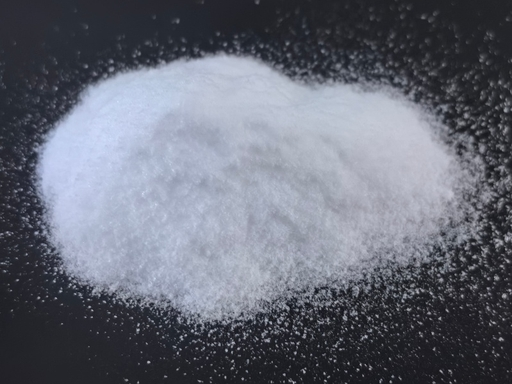
Huafluoro PFA Powder is a high-performance, white fluoropolymer powder engineered as a versatile functional additive. By combining the legendary chemical resistance of PTFE with the melt-processing flexibility of PFA, our micropowder enhances surface properties without compromising structural integrity.
✓ Exceptional Thermal Stability
✓ Universal Compatibility
Technical Description
Our High Purity PFA Powder is specifically engineered for high-performance wire and cable insulation, where thermal stability and electrical integrity are paramount.
Characterized by a Melt Flow Rate ranging from 2.0 to 30.0 g/10 min, this material supports a wide array of processing speeds and extrusion profiles. It maintains a consistent Density of 2.12 – 2.17 g/cm³ and a high Melting Point of 300 – 310°C, ensuring performance in extreme thermal environments.
Mechanically, the powder exhibits a Tensile Strength of at least 25 MPa and an Ultimate Elongation exceeding 300%, providing the flexibility required for complex cabling. Electrically, it is an industry leader with a low Dielectric Constant of 2.1 and a robust Dielectric Strength of ≥ 20 kV/mm. With a Volatile Content kept strictly below 0.05%, it ensures a bubble-free, high-purity finish for critical aerospace and semiconductor applications.
Property | Unit | Typical Value | Test Method |
Melt Flow Rate | g/10 min | 2.0 – 30.0 | ASTM D3307 |
Density | g/cm³ | 2.12 – 2.17 | ASTM D792 |
Melting Point | °C | 300 – 310 | ASTM D3418 |
Tensile Strength | MPa | ≥ 25 | ASTM D638 |
Ultimate Elongation | % | ≥ 300 | ASTM D638 |
Dielectric Constant | 1MHz | 2.1 | ASTM D150 |
Dielectric Strength | kV/mm | ≥ 20 | ASTM D149 |
Volatile Content | % | ≤ 0.05 | Internal Method |
Appearance | – | White Powder | Visual |
Applications of FEP Powder
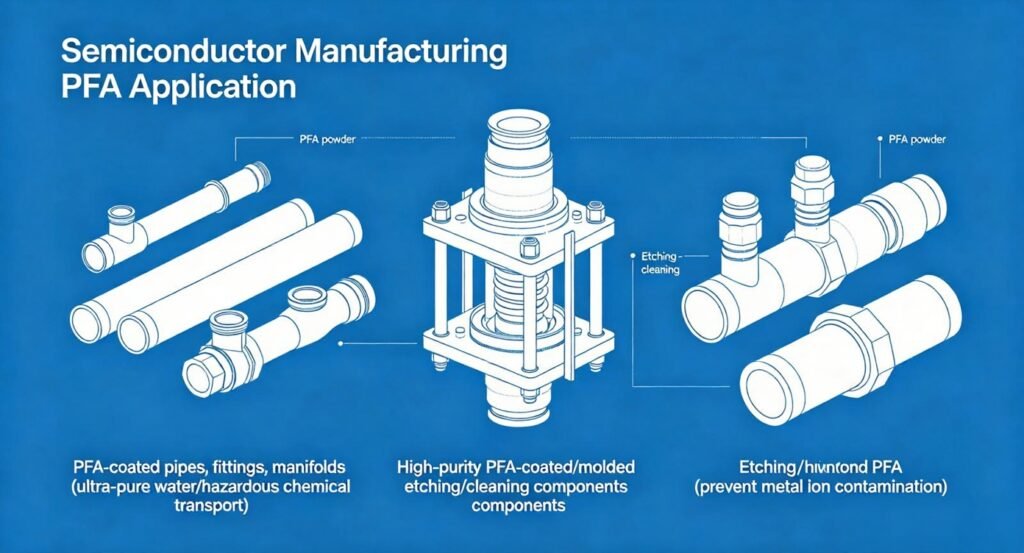
Semiconductor Manufacturing
Due to its ultra-high purity and resistance to fluorinated acids, PFA powder is critical for “clean” environments.
Fluid Handling Systems: Used for coating pipes, fittings, and manifolds that transport ultra-pure water and hazardous chemicals.
Wafer Carriers & Tools: Components used in the etching and cleaning process are often coated with or molded from high-purity PFA to prevent metal ion contamination.
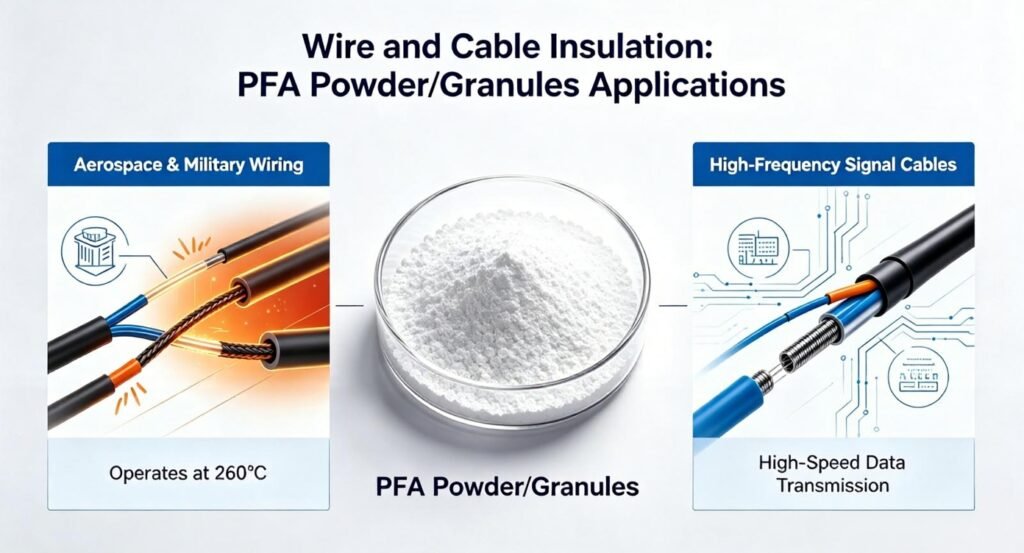
Wire and Cable Insulation
PFA powder/granules are preferred for high-speed extrusion where electrical integrity is vital.
Aerospace & Military Wiring: Used for airframe wire and mission-critical cables that must operate at 260°C.
High-Frequency Signal Cables: Its low dielectric constant ($2.1$) makes it ideal for high-speed data transmission and LAN cables.
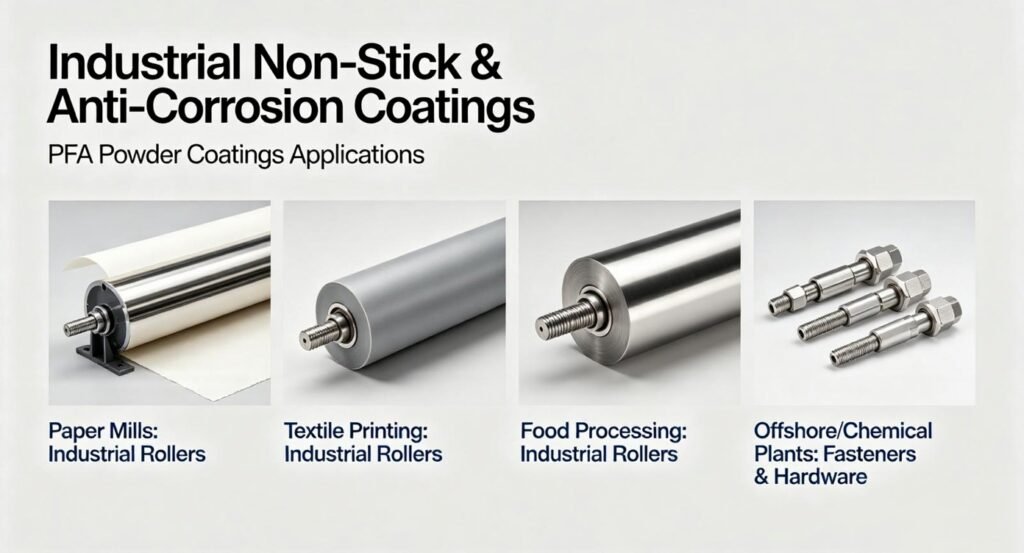
Industrial Non-Stick & Anti-Corrosion Coatings
Unlike standard PTFE, PFA powder coatings are non-porous and provide a superior barrier.
Industrial Rollers: Used in paper mills, textile printing, and food processing lines where sticky substances must be handled at high temperatures.
Fasteners & Hardware: Bolts and nuts used in offshore or chemical plants are coated with PFA to prevent “seizing” and salt-water corrosion.
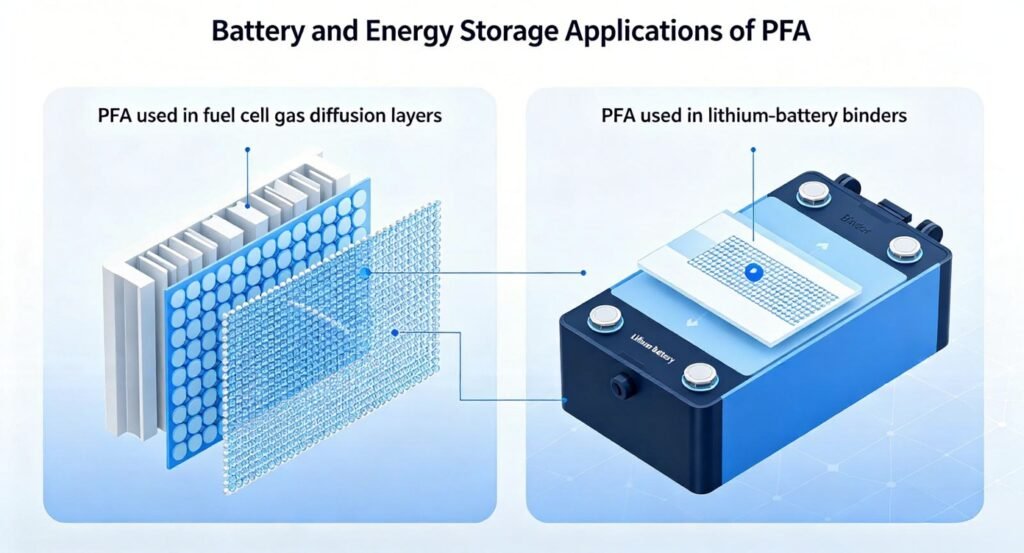
Battery and Energy Storage
Fuel Cell Components: Used in the production of gas diffusion layers due to its hydrophobic properties and chemical stability.
Lithium-Battery Binders: Emerging applications use PFA in specialized battery chemistries requiring high thermal thresholds.
FEP Powder FAQ
1. What is the difference between PFA powder and PTFE powder?
While both are fluoropolymers, the key difference lies in processability:
PTFE is “non-melt-processible.” It must be compressed and sintered (like powdered metallurgy).
PFA is “melt-processible.” It can be melted and flowed, allowing it to be used for complex injection molding, extrusion, and high-quality electrostatic powder coatings that form a non-porous film.
Performance: PFA generally has better translucent properties and much higher resistance to permeation than PTFE.
2. What are the primary coating methods for PFA powder?
There are two main ways to apply PFA powder to a substrate:
Electrostatic Spraying: The powder is charged and sprayed onto a grounded metal part, then heated in an oven to melt and fuse into a continuous coating. This is common for valves and pumps.
Rotolining: Powder is placed inside a hollow part (like a tank), which is then heated and rotated on two axes, coating the interior walls evenly.
3. What is the typical melting point and service temperature of PFA?
Melting Point: Approximately 300°C to 310°C.
Maximum Continuous Service Temperature: 260°C (500°F).
It retains its mechanical properties and chemical resistance even at these high temperatures, making it superior to FEP (which maxes out at 200°C).
4. Is PFA powder resistant to all chemicals?
PFA is virtually inert. It is resistant to almost all chemicals, including strong acids (like Hydrofluoric acid), alkalis, and organic solvents.
Exceptions: It can be attacked by molten alkali metals (like liquid sodium) and elemental fluorine at high temperatures and pressures.
Technical Support
Every industry has unique processing needs. Huafluoro R&D teams with custom PFA polymer formulations, melt flow adjustments, and packing solutions. Our technical experts help you optimize extrusion, molding, and coating performance to achieve higher efficiency and lower waste.
OEM packaging and private labeling available
On-site or remote technical assistance
Fast response for sample evaluation and quote
Related Products
Contact Us
Whether you’re interested in our products, need a quote, or have any other requirements,
we look forward to hearing from you. And you will get a perfact solution.
No.1712, Building B, 190 Donghuan Road, Jiaojiang, Taizhou, Zhejiang,China
+86 15057609941
info@huafluoro.com